When There Is No Precedent: What One-Off Cargo Teaches Heavy Logistics


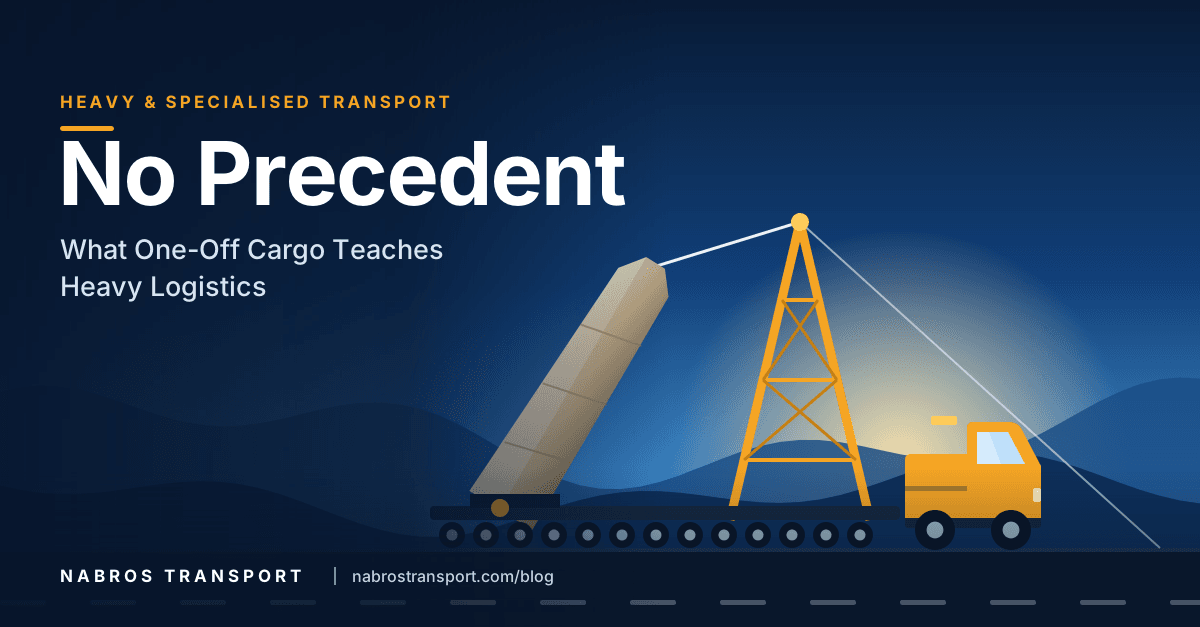
Most of logistics runs on precedent. A container has standard dimensions, a highway has known limits, and an earlier shipment shows what to expect. One-off cargo breaks that pattern. Nobody has moved this particular thing, along this particular route, in this particular condition, and the plan has to be built from first principles.
Two Nabros projects sit at opposite ends of that spectrum. One was a monolith statue whose weight changed while it was being carved. The other was five military vehicles whose size and weight were known exactly, but whose deadline could not move. Together they show what a client should expect from a logistics partner when the cargo is unusual.
What Makes a Cargo a One-Off
A one-off cargo is not simply a heavy one. It has at least one element that is unknown, changing or unrepeatable: an unusual shape, a condition that shifts, a route never used for such loads, a deadline set by other people’s schedules, or some mix of these. Standard solutions do not fit, so the work becomes engineering and coordination rather than routine haulage. The risk is also different. On a routine move, the main danger is a known problem handled badly. On a one-off move, the main danger is a problem nobody has identified yet, which is why the early questions matter so much.
Case One: A Statue That Lost 250 Tonnes
The Veeragallu monolith was carved from a single stone for the National Military Memorial in Bengaluru, for the Bengaluru Development Authority. Before carving it weighed about 700 MT. After carving it weighed about 450 MT and stood 78 feet tall. Nabros moved it 60 km from the Koira Quarry in Karnataka to Bengaluru City Centre.
The unusual part began before the journey. At the quarry, the stone had to be lifted and rotated through a full 360 degrees again and again, so that sculptors could reach every face. Each time material was removed, the weight and the centre of gravity shifted. Nabros provided continuous lifting, positioning and rotation support. In effect, logistics was working inside the creative process.
Then came the road. The quarry exit had a 45-degree incline, and the route ran through village roads with tight turning radii, congested corridors and surfaces never built for heavy transport. The responses were physical as well as planned:
- An 800 m access road was built from the quarry to the main road.
- Four turning points along the route were widened.
- A trailer and rigging setup was configured to control the 450 MT load on the descent.
- The convoy was supervised and traffic coordinated for the road movement.
On arrival, a custom-fabricated J-Stick lifting apparatus and specialised lifting towers raised the statue to vertical. Nabros stayed on the project from the moment the stone was first lifted at the quarry until it stood upright in Bengaluru.
Case Two: Five Vehicles, One Arrival
The second project had the opposite profile. There was very little that was unknown about the cargo: five military vehicles, 38 tons each, bound from Hyderabad in Telangana to Mumbai Port in Maharashtra for international deployment. The difficulty was the schedule.
In this case the timeline was a requirement, not a target. The port and the onward deployment left no room for delay, and all five vehicles had to travel together as one convoy and arrive at the same time.
The approach reflected that:
- Each vehicle was assessed individually for weight, dimensions and securing needs.
- Each travelled on its own dedicated low-bed trailer with a specified load-securing method.
- The convoy was planned, timed and supervised, with escort vehicles at all positions.
- At Mumbai Port, Nabros coordinated the handover to the port’s receiving team.
All five vehicles arrived on schedule and in full operational condition.
Five Lessons From Unusual Cargo
- Treat the unknown as something to plan around. The statue’s changing weight was not an obstacle that appeared midway. It was a condition the whole operation was designed to accommodate.
- Work with the other trades. The lifting and rotation at the quarry were coordinated with the sculptors, and the handover at the port was coordinated with the receiving team. Heavy logistics rarely works alone.
- Build what the route lacks. When the road is not there, the answer may be to make it. An access road and four widened turns turned an unsuitable route into a usable one.
- Move as a unit when the cargo must arrive as one. The brief called for a single, simultaneous arrival, so convoy discipline was part of the product being delivered. Timing, spacing, escort positions and communication all had to hold from the first vehicle to the last, and a convoy is only as reliable as its weakest stretch.
- Own the handover. The job is finished when the cargo is where the customer needs it, in the condition the customer needs. For the statue that meant standing upright. For the vehicles it meant a clean transfer to the port.
Why This Matters for Everyday Work
One-off projects are rare, but the habits they build are not. A team that has widened turns on village roads, rotated a stone weighing hundreds of tonnes and held five vehicles to a single arrival time brings the same attention to ordinary heavy moves. Questions such as “What could change?”, “Who else depends on this?” and “What does the route lack?” improve every project, not only unusual ones.
How to Brief a Partner on Unusual Cargo
When the cargo is unlike anything your logistics partner has moved before, the best briefing is honest about uncertainty. Four things help most:
- What is known precisely, and what is still unknown or likely to change.
- Any fixed dates, and who else depends on them.
- Access limits at both ends, including quarries, factories, ports and sites.
- Other parties involved, such as fabricators, riggers or port authorities.
With that, a survey and engineering review can begin on real information, and surprises are found on paper instead of on the road.
Unusual Is Where Planning Shows
A statue and a set of vehicles have little in common, except that neither arrived through a standard process. Both were delivered because every unknown was identified early, every constraint was treated as part of the design, and one team stayed responsible until the cargo was safely set down.
If you have cargo that does not fit a template, tell us what it is, what you know and what you do not. That is exactly where we like to start.
Frequently Asked Questions
1. What is one-off cargo?
It is cargo with at least one unknown, changing or unrepeatable element, such as an unusual shape, a condition that shifts, a route not normally used for such loads or a deadline set by other people’s schedules. Standard solutions rarely fit, so the plan is engineered from the start.
2. Can Nabros plan for cargo whose weight changes during the project?
Yes. In the Veeragallu monolith project, the stone’s weight fell from about 700 MT to about 450 MT as it was carved, and its centre of gravity shifted with each stage. Nabros supported the lifting, positioning and rotation throughout, coordinated with the sculpting team.
3. Does Nabros build access roads or widen turns on a route?
Where a route needs it, yes. For the statue movement, an 800 m access road was built from the quarry to the main road and four turning points were widened. Route modification sits alongside route survey in Nabros’s services.
4. How are several heavy vehicles moved together as one convoy?
Each unit is assessed individually, then the convoy is planned, timed and supervised as one. In the military vehicle project, five vehicles of 38 tons each travelled together with escort vehicles at all positions and arrived at the same time.
5. What kind of trailer is used for heavy vehicles?
It depends on the vehicle’s weight, dimensions and securing needs. In the Hyderabad to Mumbai Port movement, each of the five vehicles travelled on its own dedicated low-bed trailer with a specified load-securing method.
6. Can Nabros handle lifting and erection at the destination?
Nabros has done so on projects where the cargo needed it. For the statue, a custom-fabricated J-Stick lifting apparatus and specialised lifting towers raised it to vertical on arrival.
7. How does Nabros coordinate with other parties such as sculptors or port teams?
Coordination is built into the plan. At the quarry, lifting and rotation were coordinated with the sculpting team. At Mumbai Port, Nabros coordinated the handover with the port’s receiving team.
8. Can you work to a fixed, non-negotiable deadline?
Deadlines are treated as planning inputs from the start. For the military vehicle movement, the timeline was a requirement rather than a target, and every step, from trailer selection to convoy timing, was planned around it. Each project’s deadline should be reviewed with our team before commitments are made.
9. What should I share if my cargo is unusual?
Tell us what you know precisely, what is still uncertain and what might change. Add any fixed dates, access limits at both ends and the other parties involved, such as fabricators, riggers or port authorities.
10. Do one-off moves cost more than routine heavy transport?
Cost depends on the survey findings, the route work needed, the equipment required and the time involved, so there is no fixed answer. The most reliable way to find out is to share your cargo details and let us assess the route and requirements before a quotation is prepared.
Related Blogs
From a Repaired Leyland to a Hydraulic Fleet: What Five Decades Have Taught Nabros About Heavy Haulage

How a 466-Tonne Reactor Takes Four 90-Degree Turns: The Engineering Behind Ultra-Heavy Transport