Intercarting: The Short Moves That Keep Wind Projects on Schedule


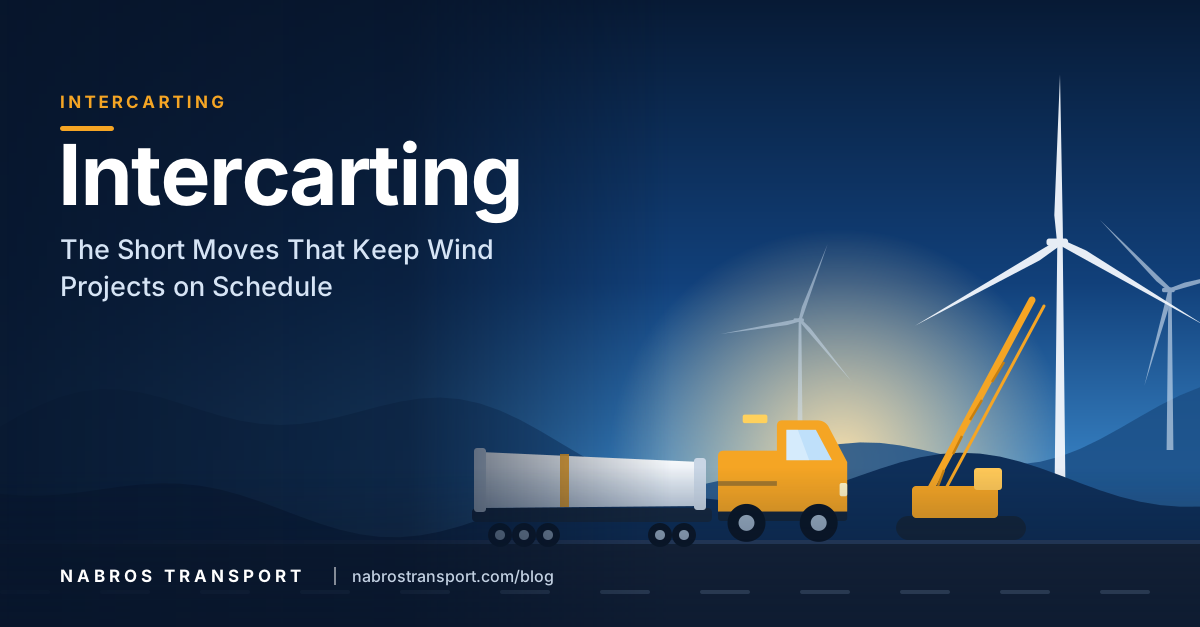
When people talk about wind project logistics, they tend to talk about the long journey: the port, the highway, the convoy that crosses states. Less attention goes to the movements that happen in the final stretch, between a storage yard and a turbine foundation, often over a few kilometres. Yet this stage can decide whether a project’s erection schedule holds or slips.
That stage is called intercarting. It is the coordinated movement of wind turbine generator (WTG) components, including blades, nacelles, hubs and towers, from zero points and storage units to project and erection sites. It sounds simple. In practice, it asks for some of the tightest coordination in the whole supply chain, and this article explains why.
What Intercarting Is and Where It Fits
A wind farm rarely receives its components in the exact order and moment they are needed. Components arrive from ports and factories in large batches, which means they need somewhere to wait. That waiting place is typically a zero point or a storage unit, a staging area near the project where components are received, inspected and held.
From there, each component must travel to its own erection site, often one turbine location at a time, so that cranes and installation crews can work without pause. Intercarting is the bridge between staging and erection. It is where a bulk delivery becomes a precise, turbine-by-turbine supply.
Because it sits at the very end of the chain, every earlier delay and every earlier decision shows up here. If a blade convoy ran late, intercarting is where the knock-on effect is felt. If a site road was not ready, intercarting is where the problem becomes visible.
Why Short Distances Are Not Easy Distances
It is tempting to assume that a short move must be simple. The opposite is often true, for several reasons.
Site roads were not built for this. Internal and approach roads on wind projects are frequently temporary or unpaved, with tight junctions, steep gradients or soft ground. A blade or tower section that passed a highway survey without difficulty may meet its first real challenge on the last kilometre.
The margin for error is smaller. On the highway, a convoy has some room to pause, reposition or choose a different lane. On a site road, there may be no alternative path. A load that cannot make a turn cannot simply go around.
Schedules are driven by cranes. Installation cranes are expensive and carefully booked. When a component is not at the foot of the turbine when the crane is ready, the cost of the delay accumulates by the hour. Intercarting is the activity that must keep the crane from waiting.
Precision, Not Just Transport
Moving a component a few kilometres involves more than driving. A good intercarting operation combines several functions.
Precise coordination. Deliveries must be sequenced against the erection plan, so that the right component, in the right orientation, reaches the right location at the right time. This depends on constant communication between the logistics team, the site team and the crane crew.
Time-sensitive execution. Intercarting is built around short windows. Components need to move when conditions allow and when the crane is ready, and then the operation must wrap up smoothly so that the installation can proceed.
Secure cargo handling. Blades, nacelles, hubs and towers are valuable and, in the case of blades, easy to damage. Handling at storage units and at erection sites needs the same care as on the road: correct lifting points, correct support, correct securing and trained people.
Route risk mapping. Even a short internal route benefits from a risk survey. Gradients, curve radii, soft patches, culverts and overhead lines are all identified before the first load moves, so that issues are handled by planning rather than improvisation.
Repositioning and Storage Management
Not every movement goes straight from the zero point to the erection site. Sometimes components need to be repositioned between storage yards, for example when a project is phased, when a section of site becomes available earlier than expected, or when a storage area has to be cleared for incoming deliveries.
Good storage management supports this flexibility. Components should be laid out so that they can be reached in the order they are needed, supported correctly while they wait, and recorded accurately so that nobody has to search for a specific blade or tower section. This is where intercarting and warehousing meet.
Connecting the Whole Chain
Intercarting does not stand alone. It depends on close coordination with ports, shipping lines, transport partners, customs teams and warehouses, so that cargo flows without interruption from arrival to installation. A delay in customs clearance can mean a storage unit that is empty when it should be full. A late convoy can mean a crane crew that is idle. A congested yard can mean a component that cannot be reached.
When the same company manages the long-haul movement and the final-stretch movement, those connections are easier to maintain. Information about what is arriving, when and in what condition passes between teams that are already working together, instead of across contractual boundaries. This is the logic behind integrated site connectivity: storage units, zero points and erection sites treated as one linked network rather than separate stops.
What Project Teams Can Do to Help
Intercarting runs best when the project team and the logistics partner share information early. A few simple steps help:
- Share the site layout, including the position of zero points, storage units and turbine locations, as soon as it is available.
- Provide the erection sequence and crane schedule, and update them as they change.
- Confirm the condition and load capacity of internal roads before components start to arrive.
- Agree on who authorises a movement, who confirms readiness at the erection site, and how last-minute changes are communicated.
The Last Mile Deserves First-Class Planning
Intercarting rarely makes headlines. Nobody celebrates a blade that reached its foundation on time and undamaged; they simply see the tower rise. But the survey, sequencing, equipment and communication behind that quiet success are what keep projects on schedule.
If you are planning a wind project or any heavy installation with a demanding final stretch, bring your logistics partner into the conversation early. The shortest part of the journey often needs the longest preparation, and we are ready to help you plan it.
Related Blogs
Breakbulk Chartering Explained: When Booking a Vessel Beats Booking Space
Road, Barge and Sea: Why Multimodal Transport Suits India’s Heaviest Cargo