How a 466-Tonne Reactor Takes Four 90-Degree Turns: The Engineering Behind Ultra-Heavy Transport


A figure such as 466.26 tonnes looks harmless on a data sheet. On a road, it turns into a chain of questions. How much pressure goes into the surface under each wheel? What does a bridge feel as the load crosses it? What happens when the road climbs, bends sharply, and the cargo cannot bend with it? Ultra-heavy transport is the discipline of answering those questions before the first wheel turns.
This article uses a single movement to show how that works. Nabros moved a 466.26 MT reactor for BHEL from Haridwar in Uttarakhand to Gadarwara in Madhya Pradesh. The reactor measured 10.2 m by 5.1 m by 4.8 m, and the route included four steeply inclined hill stretches near Gwalior, each with a 90-degree turn on a narrow road.
Heavy Is Not the Same as Large
Some cargo is difficult because of its size. Ultra-heavy cargo is difficult because of the forces it creates. Every tonne has to be carried by something: the trailer axles, the tyres, the road surface, the ground beneath it, and every bridge or culvert along the way. If any link in that chain is overloaded, either the infrastructure or the cargo pays for it.
Three questions shape almost every ultra-heavy plan:
- Distribution. The weight must be spread across as many axles as the trailer configuration allows, so that no single tyre, axle or stretch of road carries more than it should.
- Structures. Bridges and culverts have rated capacities, and the arrangement of weight along the trailer is as important as the total.
- Gradient. Pulling a load uphill demands tractive effort, and holding it back downhill demands braking control. The steeper the slope, the smaller the margin for error.
On the Haridwar to Gadarwara route, all three applied at once.
The Problem: Four Turns That Conventional Methods Could Not Handle
A long, rigid trailer combination needs a wide arc to turn. On a flat, open junction, that is a matter of lining up carefully. On a narrow hill road, with an incline underfoot and a 90-degree corner ahead, there is no spare width to swing into, and the weight that has to be controlled is nearly five hundred tonnes.
The Gwalior stretches had exactly this combination, four times over. A load of this size and weight could not be taken through them by conventional means, and the answer had to come from engineering rather than from driver skill alone.
The Solution: Two Trailer Sets, One Shared Load
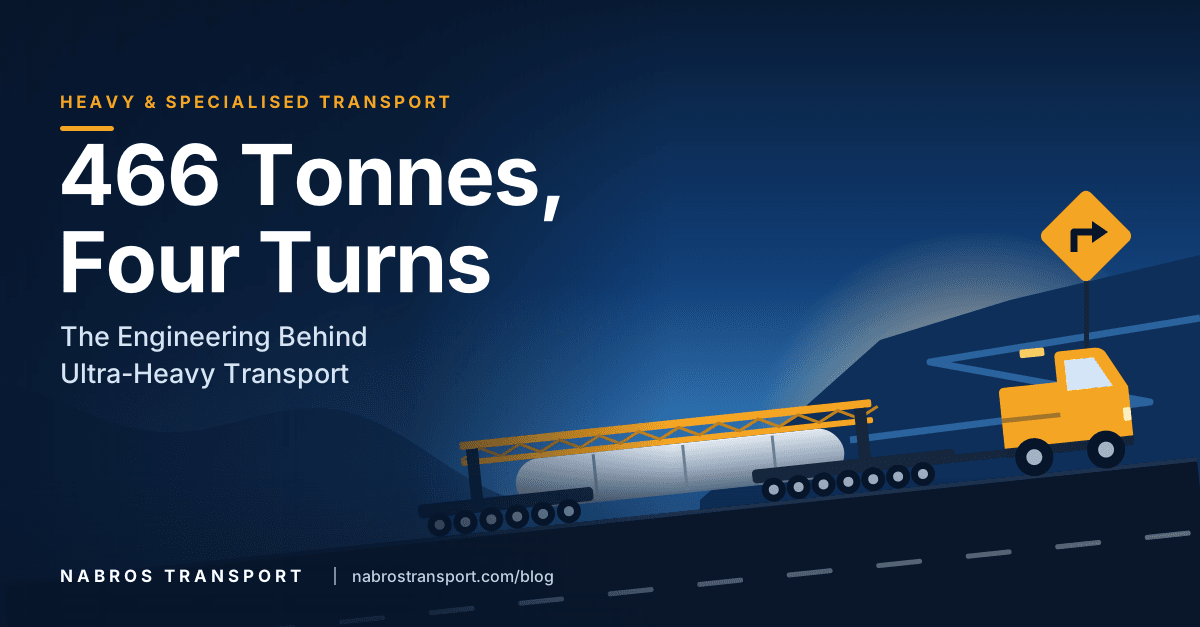
Nabros used a specially designed TIGER Girder Bridge, an arrangement that divides the load evenly between two sets of multi-axle trailers. In plain terms, the cargo is carried between the two sets instead of resting on one long trailer. Think of two people carrying a heavy beam, one at each end, rather than one person struggling with it in the middle.
The benefits were practical:
- The weight was spread over a wider footprint, which reduced point loads on the road surface.
- The convoy gained the flexibility to negotiate the turns on an incline.
- A puller vehicle formed part of the equipment, adding traction for the climbs.
None of this is improvised on the day. The configuration is designed around the cargo’s weight and dimensions and then tested against what the route will demand at its tightest points.
Surveying the Corridor, Then Clearing the Path
A route survey that records a corridor as passable is not enough for a move like this. The whole Haridwar to Gadarwara corridor was surveyed before mobilisation, and the Gwalior sections were assessed in much greater detail, down to geometry, gradient and surface condition at each of the four turns.
The survey then fed into action. Approach paths were cleared before the convoy reached each section, so that the manoeuvre itself began with the space it needed already available. This is the difference between a survey that produces a report and a survey that produces a movement plan.
Moving as One Controlled Convoy
On a normal highway, a convoy is a line of vehicles. At a 90-degree hill turn with a girder-bridge combination, it becomes a coordinated manoeuvre in which every position matters.
A dedicated escort team covered every convoy position, coordinated by an Escort Supervisor. Escort and operations staff supervised each of the four turns directly, rather than relying on instructions relayed from a distance. When several people each own one part of a manoeuvre, someone must own the whole of it, and the Escort Supervisor’s role was exactly that.
The Result
The reactor reached Gadarwara ahead of schedule, and all four 90-degree turns were completed without incident. The outcome matters less as a headline than as evidence of a method: measure the route precisely, engineer the configuration for the cargo, clear the path in advance, and supervise the hardest points in person.
Other Heavy Moves, Same Discipline
The same logic sits behind other projects in the Nabros portfolio, including a 971 MT reactor from Mundra to Bhatinda and a 1,016 MT load from Kandla to Panipat. Each route had its own geometry, its own obstacles and its own answer. That is the real lesson of ultra-heavy transport: there is no standard solution that can be taken off a shelf. What carries from one project to the next is the method, not the configuration.
What Fabricators and Project Owners Can Do
Many of the decisions that make an ultra-heavy move easier are made long before the cargo leaves the factory. Four habits help:
- Confirm the final weight and balance point early, and report any change. The figure on the drawing may differ from what comes off the shop floor, and the transport plan depends on the real number.
- Share support and lifting points. The way the cargo can be supported on the trailer constrains which configurations are possible.
- Look at the destination. Ground conditions, access and unloading arrangements at the site decide whether a perfectly executed journey can end in a safe set-down.
- Allow time for survey and preparation. Detailed corridor assessment and clearing of approach paths take time, and rushing them is the most expensive way to save a week.
Engineering First, Transport Second
Moving a 466-tonne reactor through four sharp hill turns is closer to engineering than to driving. The truck matters, but so do the calculation behind the configuration, the survey that found the problem spots and the supervision that carried the plan out at each corner.
If you have a heavy fabrication in the design or early build stage, a conversation with our team at the drawing stage will tell you far more than a quote request at the factory gate.
Frequently Asked Questions
1. What counts as an ultra-heavy load?
There is no single universal threshold. The term is generally used for cargo whose weight exceeds what standard trailers, roads and bridges can carry without special engineering. Nabros’s projects in this category run into hundreds of tonnes, such as a 466.26 MT reactor, a 971 MT reactor and a 1,016 MT load.
2. How is the weight of a very heavy load spread across trailers?
The cargo is carried on multi-axle trailer configurations designed around its weight and dimensions. Spreading the load over more axles and a wider footprint reduces the pressure on any one tyre, axle or stretch of road surface.
3. What is a girder bridge arrangement in heavy transport?
It is a configuration in which the cargo is carried between two sets of trailers instead of resting on a single trailer. In the 466.26 MT reactor movement, a TIGER Girder Bridge split the load evenly between two sets of multi-axle trailers.
4. Why are 90-degree turns on slopes so difficult for heavy cargo?
A long, rigid trailer combination needs a wide arc to turn, and a narrow hill road offers little spare width. The slope adds the need for traction uphill and braking control downhill, so the turn has to be engineered, surveyed and supervised.
5. Why is a route survey essential before an ultra-heavy move?
The survey shows where the road, bridges, turns and gradients will constrain the movement. Nabros assesses every route before cargo moves, and for demanding sections, such as the Gwalior stretches, it studies geometry, gradient and surface condition in detail.
6. Who supervises the convoy during the movement?
A dedicated escort team covers every convoy position, coordinated by an Escort Supervisor. For difficult sections, escort and operations staff supervise the manoeuvre directly on site.
7. What information do you need from us to plan a heavy move?
Please share the cargo’s weight, dimensions, centre of gravity and support or lifting points, along with the origin, destination and your target dates. Drawings help. The more accurate the data, the sooner the survey and configuration work can begin.
8. Does Nabros handle permits and approvals for heavy loads?
Yes. Permit management and regulatory approvals are part of Nabros’s heavy and specialised transport planning, alongside route survey and risk planning.
9. Can heavy loads move during the monsoon or at night?
Nabros’s safety planning includes preparation for monsoon and night movements. Whether a particular movement should go ahead depends on the route, the permits, the conditions on the day and the risks identified in the plan.
10. How early should we involve a logistics partner?
Ideally at the drawing or fabrication stage, before the final weight and dimensions are fixed. Early involvement lets the transport plan influence decisions on support points, lifting arrangements and delivery sequencing while changes are still inexpensive.
Related Blogs
From a Repaired Leyland to a Hydraulic Fleet: What Five Decades Have Taught Nabros About Heavy Haulage
When There Is No Precedent: What One-Off Cargo Teaches Heavy Logistics