Where Wind Energy Moves, Nabros Leads – Windergy India 2026


India’s installed wind capacity reached 58.14 GW as of July 2026, following a record 6.05 GW added in FY 2025-26. Reaching the 100 GW target by 2030 requires sustained annual additions of approximately 10 GW. Domestic turbine manufacturing capacity now stands at 24 GW annually, against a live construction pipeline of approximately 43 GW.
Manufacturing has scaled to meet demand. Moving what it produces to site has not kept pace.
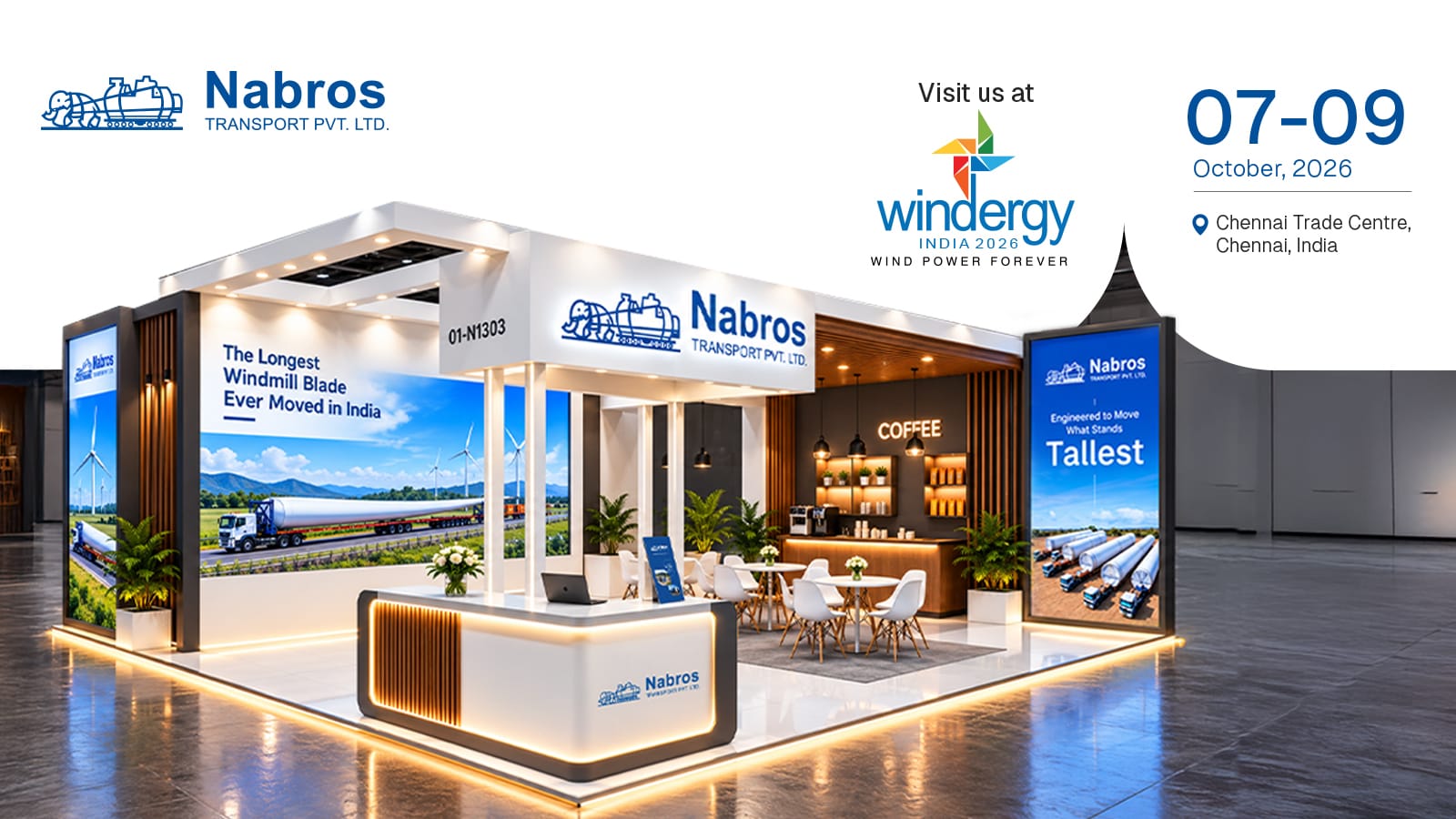
That gap, between what India is building and the logistics infrastructure required to get it there, is where Nabros operates. It is also the conversation that Windergy India 2026 exists to have. Nabros will be at Hall No. 1, Booth No. N1303, Chennai Trade Centre, from 7th to 9th October.
55+ Years in the Field
Nabros has been moving wind energy cargo since before the sector had a name for it in India. Over five decades, that has meant 10 lakh+ kilometres moved, 5 lakh+ tonnes of freight, and partnerships with over 100 clients across the wind energy sector and beyond, including Vestas, Inox Wind, Envision Energy, Enercon, Suzlon, GE Renewables, Nordex, and Nova Wind Russia.
That record runs on a fleet engineered specifically for this cargo class.
The Fleet
Wind turbine components do not move on general freight vehicles. Each component type, whether blade, tower section, hub, or nacelle, has specific dimensional and load requirements that demand purpose-built equipment. Nabros’ fleet is built around those requirements: 60+ extendable telescopic trailer sets for blade transport, 45+ low-bed trailer sets for tower sections, 500+ hydraulic axles for nacelles and heavy lift components, and 200+ escort vehicles for convoy coordination and safety.
Every vehicle in this fleet is operated and maintained in-house. There are no subcontracted gaps in the chain.
Turnkey Wind Movement
WTG movement at Nabros runs door to site. Route survey, permit coordination, component transport, intercarting from zero point to erection site, and on-ground execution are managed end to end under a single point of accountability.
This matters because wind energy logistics is not a last-mile problem. It begins at the point of manufacture and ends at the erection site, and every stage between those two points carries the risk of delay, damage, or missed commissioning windows if it is not managed with the same discipline throughout.
Three Movements That Define What This Actually Means
Wind turbine components are not difficult to move in theory. They are difficult to move in practice, on Indian roads, through Indian terrain, under Indian infrastructure, on timelines set by project commissioning schedules that do not flex. The three movements below represent the three distinct logistics challenges the wind energy sector regularly faces: extreme blade length, sustained high-volume operations, and cross-border international movement.
90.2 m Blade, Thoothukudi to Koppal
At 90.2 m, this was among the longest wind turbine blades ever transported on Indian roads. The route from Thoothukudi to Koppal required traversing the ghat sections of Dharmapuri, Namakkal, and Salem, with steep gradients, tight turning radii, and restricted road corridors that leave no margin for error on a load of this length. Every section of the route was surveyed and engineered before the trailer moved. The blade reached Koppal safely and on schedule.
This movement is relevant to any developer or OEM working with next-generation turbines where blade lengths are pushing past conventional transport limits. The route engineering capability that made this possible is the same capability Nabros brings to every wind logistics project.
1,000+ Blades, Vestas Bavla to Kandla Port
Over 1,000 blades, each 59 m in length, moved from the Vestas manufacturing facility at Bavla, Gujarat to Kandla Port. The scope included road transportation, port operations, and vessel hook delivery across multiple shipments sustained over an extended programme.
This movement is relevant to OEMs and developers managing high-volume, recurring logistics requirements. Moving one blade well is a capability. Moving a thousand of them, to the same standard, on a continuous programme, is a different order of operational discipline entirely. That is what this project demonstrates.
1,200 Blades, Dobaspet to Novorossiysk, Russia
For Nova Wind Russia, 1,200 blades moved from the manufacturing facility in Dobaspet to Novorossiysk via Tuticorin Port. The scope included factory transportation, full vessel chartering at 39 blades per shipment, port operations, cross-border customs clearance, and vessel hook delivery in Russia.
This movement is relevant to any developer or OEM with international supply chain requirements. Wind energy logistics does not stop at the Indian coastline. Nabros manages the full international scope, covering chartering, documentation, customs, and destination coordination, under the same single point of accountability as the domestic movement.
For Nova Wind Russia, 1,200 blades moved from the manufacturing facility in Dobaspet to Novorossiysk via Tuticorin Port. The scope included factory transportation, full vessel chartering at 39 blades per shipment, port operations, cross-border customs clearance, and vessel hook delivery in Russia.
This movement is relevant to any developer or OEM with international supply chain requirements. Wind energy logistics does not stop at the Indian coastline. Nabros manages the full international scope, covering chartering, documentation, customs, and destination coordination, under the same single point of accountability as the domestic movement.
Safety
Dedicated QEHS Officers are stationed at critical loading locations including Trichy, Kandla, and Tuticorin. Alcohol screening is mandatory before every ODC movement, with records formally documented and shared with the EHS team. Surprise breath analyser checks are conducted by HSE Officers throughout operations. A dedicated Quality Officer at Head Office conducts direct safety briefings with drivers before every movement.
The fleet operates on Intangles AI-based GPS tracking, providing real-time alerts for vehicle health, overspeeding, harsh driving, and halts. Every convoy operates under dedicated Escort Supervisors, with dash cameras installed across all escort vehicles. Drivers, escorts, and field teams undergo structured training and safety briefings conducted both in-person and virtually. Routes are pre-planned for traffic, road damage, and seasonal disruption, with enhanced escort support during monsoon and night movement.
Beyond Wind, the Same Discipline
The engineering approach Nabros applies to wind energy logistics is the same approach brought to every complex cargo assignment. Two movements illustrate the broader capability.
A 971 MT VGO HDT Reactor moved from Mundra Port to HMEL Bhatinda across three states, Gujarat, Rajasthan, and Punjab, crossing 68 major and minor bridges via specially constructed bypasses, 19 canals on custom-fabricated trestle bridges, and 12 railway overbridges through dedicated bypass construction. Delivered on time.
A 1,016 MT HDT Reactor moved from Kandla Port to IOCL Panipat for Larsen and Toubro, on a 28-row axle configuration with 56 axle lines in a 1+1 width setup and 16 tyres per row. A new national benchmark in heavy-haul logistics.
Nabros also operates internationally, managing project logistics across 27 countries spanning Europe, North America, the Middle East, Africa, and South East Asia.
Meet Nabros at Windergy India 2026
Windergy India brings OEMs, EPCs, and developers into the same room as the companies responsible for moving what the sector produces. The conversation about logistics, about routes, about blade lengths, about what the next decade of wind energy growth actually demands on the ground, needs to happen before projects are commissioned, not after.
Nabros will be at Booth N1303 for that conversation.
Windergy India 2026
7th to 9th October 2026
Hall No. 1, Booth No. N1303
Chennai Trade Centre, Chennai, India
To schedule time with the Nabros team ahead of the event, write to devansh@nabrostransport.com or madhusudan@nabrostransport.com.
Related Blogs
Intercarting: The Short Moves That Keep Wind Projects on Schedule
Breakbulk Chartering Explained: When Booking a Vessel Beats Booking Space