Road, Barge and Sea: Why Multimodal Transport Suits India’s Heaviest Cargo


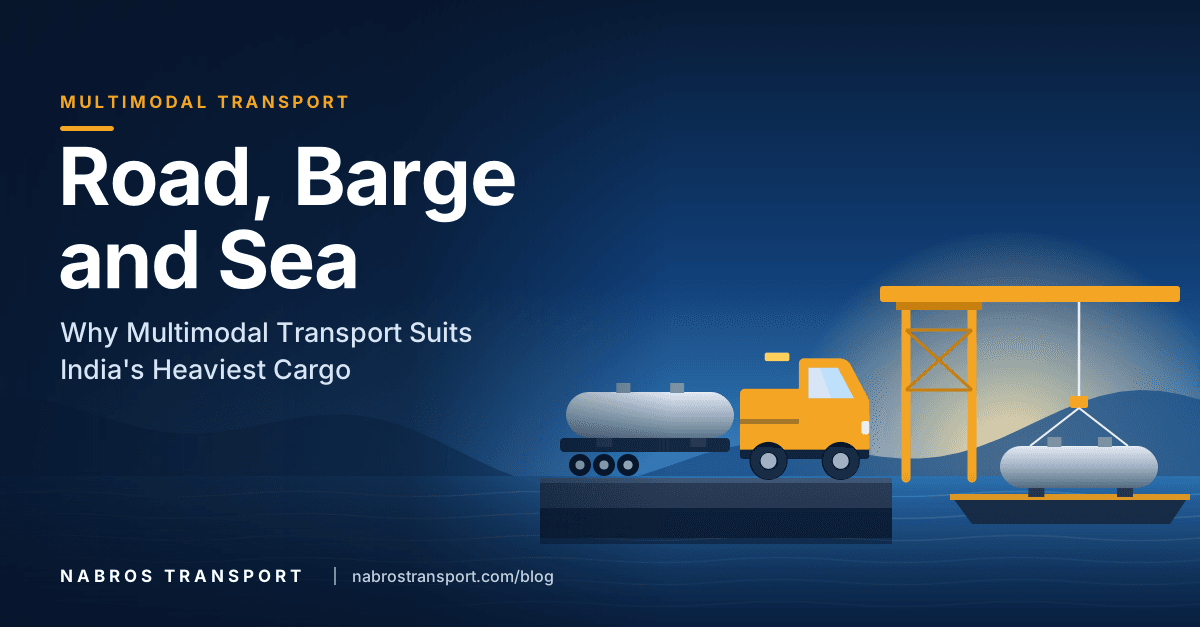
Ask a logistics manager to move a 400-tonne reactor from a fabrication shop to a refinery and the first instinct is to open a road map. Within an hour, the map usually starts to argue back. Bridges are rated for far less than the load. Villages sit where the highway narrows. A direct road route that looks short on paper turns out to be a sequence of obstacles that would each need to be strengthened, widened or bypassed.
This is the situation in which multimodal transport earns its place. Rather than forcing one mode to do a job it was never suited for, a multimodal plan uses road, rail, inland waterway or sea for the legs where each performs best, and joins them into one controlled journey. This article looks at how that works for India’s heaviest and most awkward cargo, and why the real skill lies in the joins between modes, not in the modes themselves.
What Multimodal Actually Means
Multimodal transport is the movement of cargo by two or more modes under a single transport contract. The phrase “single contract” matters as much as the phrase “two or more modes”. A shipper who books a trailer from one company, a barge from another and a vessel from a third has not bought a multimodal service. They have bought three separate services and taken on the job of coordinating them, along with the risk that falls into the gaps between them.
In a true multimodal arrangement, one party plans the full chain, owns the handovers and answers for the outcome from origin to destination. That is the approach Nabros takes, because for heavy cargo the handover points are exactly where most problems begin.
When Road Alone Is Not Enough
Road transport remains the backbone of heavy haulage in India, and Nabros moves enormous loads by road every year. But some movements are better solved by combining modes:
- The load exceeds what the road network can carry. Weight, height or width may rule out sections of highway or specific bridges, and the cost and time of modifying infrastructure can exceed the cost of going around it.
- Origin or destination sits near water. Fabrication yards, ports and projects close to a coast or river often allow a barge or vessel to take the longest, hardest part of the journey.
- The cargo is crossing borders. Exports and imports naturally involve sea or air legs, and the inland portions at each end must connect to them cleanly.
A well-known example is the multimodal movement of a 400 MT DHT reactor for L&T Heavy Engineering, which combined road, barge and marine legs across 1,619 km and was completed in a record transit period of 47 days. The lesson lay in the planning: the right mode for each stretch, and transitions timed tightly enough to hold the schedule.
The Handover Is Where Risk Lives
Every time cargo changes mode, it is lifted, rolled, skidded or lowered by equipment that must be matched to its weight and shape. That is why transfer points deserve more attention than they usually get.
At a jetty or quay, planners need to know the bearing capacity of the ground, the capacity and reach of the available cranes, the height of the tide and the draft alongside, and the dimensions of the ramp or deck onto which the cargo will move. Each of these can quietly limit the whole operation. A load that fits on the trailer and fits on the barge may still not be transferable if the quay cannot support the equipment needed to do it.
Securing is a related concern. Lashing that is perfectly adequate for a road journey will not necessarily be adequate for a sea passage, where motion is different and sustained. Each mode brings its own forces, and the securing plan has to account for all of them in sequence rather than assuming that what worked on one leg will work on the next.
Planning Backwards From Delivery
The most reliable multimodal plans are built backwards. Start with the date and condition in which the cargo must arrive. Then work out which transfer points the journey must pass through and what each one needs: a tide window, a vessel or barge slot, a road permit, a clearance, a crane booking. Only then does it become possible to see whether the schedule is realistic, and where buffers should be placed.
This exposes dependencies that a forward plan can miss. A barge slot is no use if the road permit for the approach leg takes longer, and a vessel cannot load if the customs paperwork is not ready. Managed together, such conflicts surface in planning, where they cost almost nothing to fix.
Documentation and Customs Across Modes
Transport documents, state permits, port permissions and customs paperwork all have to line up with the physical movement, and delays here are a common cause of missed schedules.
Having customs clearance handled in-house is a real advantage in this context. When the team planning the transport is the same team preparing and submitting the clearance, there is no gap in which a missing document can sit unnoticed. Cargo reaching a port finds its paperwork waiting for it, and the next leg can begin without a pause.
International Examples of the Same Principle
The same logic applies across borders. Cold box modules for the ITER project moved from Switzerland to France, and a 40-ton transformer travelled from Hyderabad to Doncaster in the United Kingdom. In both, success depended on treating the journey as one continuous operation rather than a series of unrelated bookings.
Is Multimodal Always Cheaper?
Not always, and it is worth being honest about this. A multimodal plan involves more handovers, more equipment and more coordination than a direct road movement, so it should not be assumed to cost less on a line-by-line basis. The right comparison is the total cost of delivery, including what the alternative would require. If a road-only route needs bridge strengthening, road modifications, long escorts and extended permits, the apparent saving disappears quickly. If the road route is clean and short, it will almost certainly be the better choice. The value of an experienced partner is partly in telling you which situation you are actually in.
What Shippers Can Prepare
A little groundwork makes a large difference to multimodal planning:
- Provide accurate dimensions, weight and centre of gravity for the cargo, along with lifting and lashing points.
- Share the required delivery date and how much flexibility exists around it.
- Identify any known constraints at origin or destination, such as access roads, ground conditions or site restrictions.
One Journey, One Responsible Partner
Multimodal transport works best when it feels like a single journey to the customer, however many modes it uses behind the scenes. That is the standard Nabros sets for every project: mode integration, route optimisation, real-time visibility and clear ownership from the first lift to the final delivery. If your cargo is too heavy, too large or too far for a single mode, talk to us early and we will help you map the journey that makes sense.
Related Blogs
Intercarting: The Short Moves That Keep Wind Projects on Schedule
Breakbulk Chartering Explained: When Booking a Vessel Beats Booking Space