
Breakbulk Chartering Explained: When Booking a Vessel Beats Booking Space


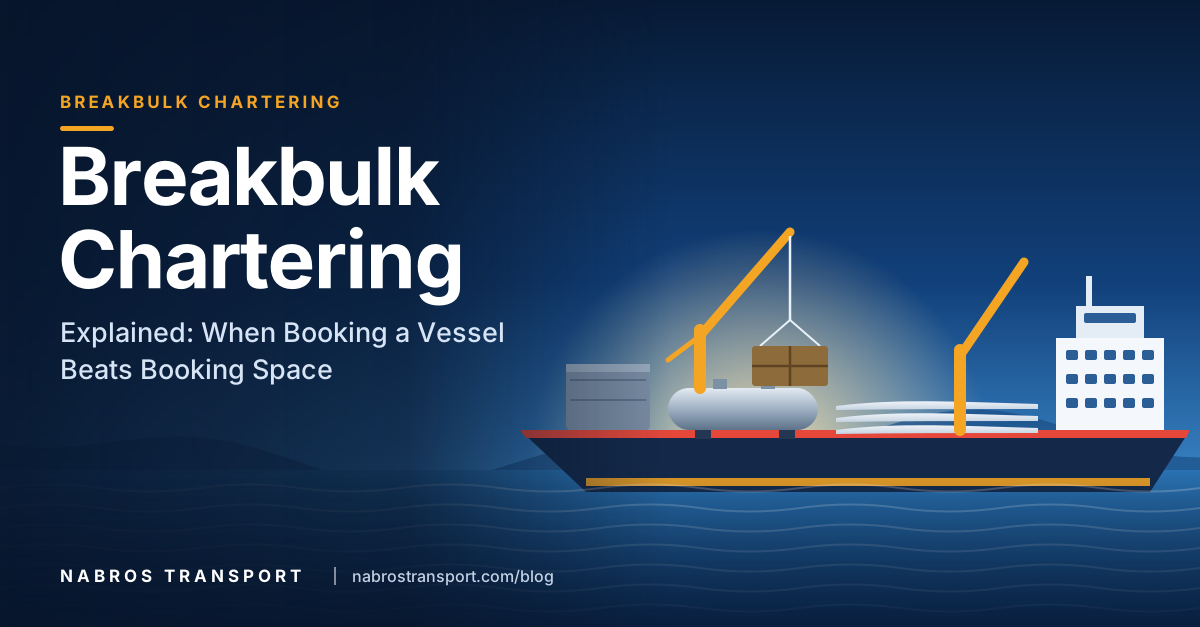
Most of the world’s trade travels in steel boxes. But a wind turbine blade will not fit inside a container, and neither will a locomotive, a reactor or a fabricated process module. For cargo like this, shipping works differently. The cargo is loaded, carried and unloaded as individual pieces, and the vessel itself is often arranged specifically for the job. This is breakbulk chartering, and it is one of the least understood and most valuable tools in project logistics.
This article explains what breakbulk chartering involves, when it makes sense, and what shippers should prepare before they begin. The aim is practical: by the end, you should be able to tell whether a chartered vessel is the right answer for your cargo, and what questions to ask your logistics partner.
What Breakbulk Cargo Is
Breakbulk is cargo that cannot be placed in a standard shipping container, either because it is too large, too heavy, too irregular or simply too valuable to be treated as one of many boxes. Typical examples include machinery, steel structures, transformers, industrial equipment, rolling stock and long components such as turbine blades. Each item is loaded individually using specialised handling methods, positioned carefully on deck or in the hold, secured against the forces of the voyage, and discharged individually at the other end.
That individual treatment is what makes breakbulk both powerful and demanding. The cargo gets handling designed around its own shape and weight, but someone has to design that handling, and it has to work at both ports.
Chartering Versus Booking Space
When cargo goes in a container, the shipper books space on a scheduled service and the carrier handles the rest. Breakbulk can work this way too, with cargo accepted on a liner-type vessel, but for larger or more complex shipments the better answer is often to charter.
Chartering means arranging a vessel, or part of one, for a specific voyage. There are two broad variations:
- Full vessel charter. The shipper arranges a whole vessel for its cargo. This suits large volumes, very long or heavy items, or situations where timing and handling must be fully controlled.
- Partial vessel charter. The shipper takes only the portion of the vessel it needs, sharing the voyage with other cargo. This can balance cost and control when the shipment is meaningful but does not justify a full vessel.
Which is right depends on cargo volume, project timelines and destination requirements. A good partner will lay out both options against your actual schedule rather than defaulting to the one that is easier to arrange.
Why Charter at All?
There are four common reasons shippers choose a chartered solution.
Fit. Some cargo simply does not suit scheduled services. Its dimensions, weight or lifting requirements need a vessel with the right deck space, hatch openings, cranes or heavy lift capacity.
Control. A chartered or partly chartered vessel can be planned around the project. Loading order, stowage, sailing windows and discharge sequence can all be shaped to match the installation schedule rather than the carrier’s timetable.
Volume. When a project involves hundreds or thousands of identical components, such as the 1,200 blades exported to Novorossiysk for Nova Wind Russia, a dedicated approach can be more economical and far more predictable than fragmented bookings.
Risk management. Valuable or sensitive cargo benefits from a stowage plan, lashing design and handling method that are engineered for it specifically, rather than adapted from standard practice.
What Goes Into a Good Charter
A chartered voyage is far more than a booking. Several pieces of planning have to come together.
Vessel selection. Not every vessel suits every cargo. Planners match the cargo’s dimensions, weight and lifting points against the vessel’s deck strength, hatch size, onboard cranes and stability characteristics. Choosing the wrong vessel can create problems that no amount of good handling can fix later.
Cargo engineering. The stowage plan and securing arrangement are designed with the specific cargo in mind. Sea-fastening must withstand the sustained motion of a voyage, which is a very different demand from road transport.
Port coordination. Both load and discharge ports must be able to receive the vessel and the cargo. That means berth availability, quay strength, crane capacity, storage space and local regulations all need to be confirmed well in advance.
Customs clearance. Cargo that arrives or departs without its customs paperwork in order sits idle, and idle cargo on a chartered vessel is expensive. Having clearance handled in-house keeps the physical and documentary flows aligned.
Time Is the Real Currency
The commercial terms of a charter typically include a defined period for loading and discharging. If operations take longer than planned, additional charges can apply, and if they finish early, some arrangements reward the shipper. This means that the efficiency of port operations, the readiness of cargo and the quality of coordination directly affect cost.
For that reason, breakbulk chartering rewards preparation. Cargo that is ready, documented and positioned when the vessel arrives saves money, and cargo delayed at the gate costs it.
From Locomotives to Chemicals: Range in Practice
Breakbulk chartering covers a wide range of cargo. Nabros has handled the global movement of a 117 MT locomotive. It has also managed PTA shipments from Asia to India, a very different cargo that benefits from the same discipline of planning, vessel selection and port coordination. Together they show how breakbulk thinking applies whether the cargo is a single heavy asset or a large, repeated flow.
Questions to Settle Before You Start
Preparation before approaching a charter pays for itself. These are the items that help most:
- Accurate dimensions, weights and lifting points for every piece of cargo, supported by drawings where available.
- Packing details and any special handling or protection requirements.
- The load port and discharge port, and any known restrictions at either.
- Your earliest and latest acceptable dates, and how firm they are.
- Whether the cargo is a single shipment or a continuing programme that could be planned as a series.
Sharing this information early allows your partner to test options, such as a full charter against a partial one, before commitments are made.
What Shippers Can Prepare
Chartering a vessel is only part of the task. The true value comes from combining vessel selection, cargo engineering, port operations and customs clearance into a single coordinated service. When these functions are separated, responsibility becomes unclear and delays become harder to resolve. When they sit with one partner, the whole voyage can be planned as one project.
That is the approach Nabros brings to breakbulk chartering: engineering-led thinking at every stage, from the first conversation about your cargo to its final discharge. If you are weighing a chartered vessel against other options, speak to us early, and we will help you compare them honestly.
Related Blogs

Intercarting: The Short Moves That Keep Wind Projects on Schedule
Road, Barge and Sea: Why Multimodal Transport Suits India’s Heaviest Cargo